Showing posts with label DVD. Show all posts

Friday, 20 February 2026

DOCTEUR CARAÏBES (ORTF, 1973)

In Guadeloupe, a dashing doctor confronts gangsters and a mysterious adversary.

Docteur Caraïbes is an European adventure series made in 1968 for ORTF (Office de radiodiffusion-télévision française) and composed of  4 x 90-minute TV moviesL'Or de l'Astrolabe, Amende honorable, Le Pigeon bleu and L'Homme à l'Albatros. Each was split into 3 x 30-minute episodes. ORTF aired Docteur Caraïbes on the Deuxième chaîne from January 17, 1973 to February 12, 1973 as 12 half-hour episodes. Jean-Pierre Decourt, the director of Rocambole (1964-1965), Lagardère (1967) and five episodes of Arsène Lupin (1971-1974), helmed the series. The scenario was written by  Marcel Jullian (Le CerveauLes Enquêteurs associés), Jean-Pierre Decourt and Raymond JacquetFilmed in English and dubbed in French, Docteur Caraïbes was co-produced by Telecip and ORTF with British film laboratories Humphries Holdings Ltd and Italian company Firmfilm

Humphries planned to expand its activities into the production field. Man with the Albatross/The Man and the Albatross (L'Homme à l'Albatros) was chosen as the first of four Dr. Caribbean feature film versions of the TV movies due to be distributed in the UK and Commonwealth between 1968 and 1969 (1). When the Deuxième chaîne showed Docteur Caraïbes, Telecip was the successful producer of Les Nouvelles Aventures de Vidocq (1971-1974), Aux frontières du possible (1971-1974) and La Demoiselle d'Avignon (1972) with Louis Velle and Marthe Keller. Written by Louis Velle with author and scriptwriter Frédérique Hébrard, his wife, La Demoiselle d'Avignon gave the actor, playwright and writer a huge popularity (2). The same year, French viewers saw him in Le 16 à Kerbriant and L'Homme qui revient de loin (a Telecip production). He was chosen for the lead role of Docteur Caraïbes by Jean-Pierre Decourt after Jean Piat, the star of Lagardère, turned it down (3)

Louis Velle plays Dr. Marc Saint-Jacques, aka "Doctor Caribbean", a physician-scientist working in Guadeloupe. Marc is caught in a shooting on the beach where a sailor named Jeff is targeted  by mobsters in white hats and suits (the "Sea Fleas gang") and their boss NeronInspecteur Philippe ("Phil"), a friend of Marc, interrogates him and Jeff. Saint-Jacques investigates on his own while Dr. Laura Méline, his new assistant, would prefer him to focus on science. Neron works for Denniger, an enigmatic millionaire. Jeff is played by Jess Hahn, an American actor settled in France. The French public watched him in numerous cinema and television productions done in Europe such as The Trial (1962), Topkapi (1964), Les Barbouzes (1964), Les Saintes Chéries (1965-1970),  L'Île Mystérieuse (1973), and many others.

English actress Suzanna Leigh (Laura Méline) was seen in Paradise, Hawaiian Style (1966), Deadlier Than the Male (1967) or The Persuaders! (1971). Italian character actor Tiberio Murgia (After The Fox) is Tiberio, a junk dealer. Murgia and Jess Hahn were in Le Saint prend l'affût (1966). Georges Aminel, an actor of Martinican origin, plays Phil. Aminel was a member of the Comédie-Française from 1967 to 1972. Best remembered as the French voice of Darth Vader in three Star Wars movies, he dubbed Yul Brynner or Orson Welles. Denniger is portrayed by Paul Massie, a Canadian-born actor. His resume includes Orders to Kill  (1958), The Two Faces of Dr. Jekyll (1960), The Rebel (1961) and roles in No Hiding Place (1961),  The Avengers (1965), etc. In 1974 Paul Massie changed careers to be a theatre professor for the University of South Florida.

Jean Négroni (Neron) was mainly a theatre actor and director but he appeared on television and in movies, amongst which Le Deuxième Souffle (1966), L'Alpagueur (1975) and I... comme Icare (1979). He was the narrator of La Jetée (1962) and the French dubbing voice of Ben Kingsley in several films. In L'Or de l'Astrolabe, Marc and Laura help Jeff and Rosa (Viviane Ventura) against Neron, who covets a treasure. The friendship of Marc and Jeff is put to the test in Amende honorable. The latter must pay a big fine for rum trafficking, though he's innocent, or he'll lose his boat. In Le Pigeon bleu, Laura is under the surveillance of Neron's chauffeur (François Jaubert), CIA agents Malan (Bill Hutchinson) and Watson (Matt Zimmerman, Thunderbirds), and a photographer (Armando Francioli). Hitchcock actress Tippi Hedren (The Birds, Marnie) is the special guest star of L'Homme à l'Albatros as Sonia.

The other main actors of Docteur Caraïbes are Gino Lazzari (Red) and Philippe de la Cruz (Apollino). Exec produced by Robert Velin. English version produced by Donald Getz. Michel Wyn, the line producer and second unit director, later helmed La Demoiselle d'Avignon and L'Homme qui revient de loin. Music composed by Jack Arel (Aux frontières du possible) and performed by Le Grand Orchestre de Paul Mauriat, conducted by Pierre Dutour. End title Sous un ciel de feu sung by Herbert Léonard. Music by Jack Arel, Lyrics by Vline Buggy (4). Cinematography by André Dumaître. Editing by Renée Lichtig (Coplan FX18 casse tout) and Peter Sykes (The Avengers), assisted with Phil StevensClarin Scott and John House. Stunts by Daniel PercheDocteur Caraïbes was shot in Guadeloupe (Pointe-à-Pitre, Deshaies...) from May to August 1968.

The expansion of  Humphries Holdings didn't turn as intended. On Docteur Caraïbes, the company is only credited for its laboratory work (not as a co-producer). A cinema version of L'Or de l'Astrolabe surfaced in French theaters in July 1970 under the title of Docteur Caraïbes. The four TV movies were released in France on VHS in the 1990s by Koba Films Vidéo (5). The 12 half-hour episodes are available on DVD since 2021 thanks to Elephant Films and its collection Les Joyaux de la Télévision. They are the best way to enjoy the entertaining Docteur Caraïbes. Louis Velle is a perfect action hero with panache and humour. Jess Hahn is an excellent sidekick. Suzanna Leigh is basically a James Bond girl of the era. Georges Aminel, Paul Massie and Jean Negroni are great. Director Jean-Pierre Decourt continued to helm important TV productions like Schulmeister, espion de l'empereur (1971-1974), Les évasions célèbres (1972), Trois Mâts pour l'Aventure (1973), Michel Strogoff (1975) or Kidnapped (1978). 

Louis Velle returned to the adventure genre with L'étrange Monsieur Duvallier (1979), a series based on the Raner novels by Claude Klotz. After La Demoiselle d'Avignon, Frédérique Hébrard and Louis Velle did Le Mari de l'Ambassadeur (1990), Le château des oliviers (1993) and Le Grand Batre (1997).

(1) Box Office, September 1968.
(2) Before La Demoiselle d'Avignon, Frédérique Hébrard and Louis Velle penned Comment ne pas épouser un millionaire (1966).
(3)  Jean Piat preferred the movie La Tour de Nesle (1968). Later Jean-Pierre Decourt offered him the lead role of Arsène Lupin but the actor turned it down too.
(4) Pseudonym of lyricist Liliane Konyn, who worked for Claude François, France Gall and others. For Herbert Léonard she also wrote Pour le plaisir (1981) or Puissance et Gloire, the end title song of Chateauvallon (1984).
(5) A subsidiary of Koba Films, the company founded by Frédérique Hébrard and Louis Velle in 1973.
 
 
See also:
 

Tuesday, 11 February 2025

BLAUES BLUT/BLUE BLOOD (ZDF, 1990)

A penniless young Bavarian aristocrat becomes a private investigator in this lavish German series shot in five countries and created by... Brian Clemens.

Count Heinrich von Alternberg, who prefers to be called Henry Altern, returns to the family castle in Bavaria. His mother, Countess Simone von Alternberg, explains him that his deceased father left them with debts. Henry wants to discuss the situation with Carl von Alternberg, his uncle, but Carl is preoccupied by the disappearance of his secretary. He just fired a P.I. named Kümmel because the man was unable to find her. Henry tells his uncle he can do a better job than Kümmel. Assisted with journalist Lisa Prentice, his ex-wife, Henry Altern investigates. Blaues Blut (sold internationally as Blue Blood) is a 10 x 52-minute detective series aired by German pubcaster ZDF from January 15, 1990 to March 19, 1990.

Blaues Blut/Blue Blood was produced for the early evening schedule of ZDF by Tele-München fernseh gmbh + Co, a Herbert G. Kloiber's TMG (Tele München Group) company.  Its creator is the legendary English scriptwriter and producer Brian Clemens (1931-2015), who wrote all the episodes. His credits include some great TV series of the 1960s and 1970s such as The Avengers, The Persuaders!, The New Avengers, Thriller or The Professionals. Blue Blood  was initially set in the U.K. and centered on a young British aristocrat but TMG and ZDF got interested in the project, hence a few changes. Years before, the ARD network was the home of Graf Yoster gibt sich die Ehre (1967-1977) and its sleuthing count. Crime author Claus Beling, then the ZDF controller in charge of Blaues Blut, is a fine connoisseur of England.

French state television Antenne 2, Italian pubcaster RAI and Televisión Española joined as co-producers. CBS Broadcast International put some money too. Austrian stage, film and television actor Albert Fortell, seen in La nouvelle malle des Indes (1981), Who Dares Win (1982), Lime Street (1985-1986) and Little Nikita (1988), was chosen to play Henry Altern without an audition. German actress Ursula Karven (Das Erbe der Guldenburgs) was cast as Lisa after other European actresses were considered. French-born Hollywood star Capucine (Germaine Lefebvre), who worked alongside John Wayne, William Holden or Peter Sellers, naturally brought her class and distinction to Simone von Alternberg (1)

The series was shot  in English but dubbed in the same language by Albert Fortell and a cast of American actors in Los Angeles. Then, it was dubbed in German for ZDF. Production of Blue Blood started in 1988, preceded by a 90-minute pilot titled Scandalous. Helmed by British director Robert Young (Vampire Circus), Scandalous was filmed in Munich, Tutzing, Freising, Château de Champs-sur-Marne, Picardie and at Bavaria Studios. The guest cast includes American model and actress Lauren Hutton, Friedrich von Thun, Horst Janson (Captain Kronos - Vampire Hunter), Peter Kuiper, Didier Flamand, Didier Sauvegrain, Jean Bouchaud, Gérard Buhr, Michel Peyrelon, etc. Even Patrick Paroux (uncredited), known today as Monsieur Parizot in Camping Paradis and its spinoff.  

Scandalous was aired by ZDF in two parts  as episodes 7 and 8 (Der Skandal - Teil 1 and Der Skandal - Teil 2: Das Ende feiner Herren). It was released on VHS in Germany as Blue Blood - Leben und Sterben in der Society (1988) and in the U.S. as Scandalous (1989). Robert Young directed another episode, Schatten der Vergangenheit/Who was that man, shown as the sixth episode by ZDF and shot in Paris. An American woman recognizes her husband, killed in Vietnam, at a concert. Marisa Berenson (Barry Lyndon) and Günther Maria Halmer guest star. Jean Bouchaud returns as the inspector from Scandalous. With Arthur Brauss, Gérard Buhr (playing a different role than in the pilot), Jacques Marin (Marathon Man, The Island at the Top of the World), the multi-talented actress, singer and novelist Ysabelle Lacamp, etc. Technisonor provided the production services in France.

A British insurance broker asks Henry to prove a criminal dead in a plane crash is alive in Wer zweimal lebt, stirbt einmal mehr/Bounty (the first episode on ZDF).  Scottish director Sidney Hayers, a regular collaborator of Brian Clemens, reunited with Lewis Collins (The Professionals) for the occasion and a ski chase was filmed in the Austrian Lech valley. Guest star Barbara Wussow (Die Schwarzwaldklinik) married Albert Fortell in 1990. Henry Altern must drive to Rome an ambulance carrying the key witness of a corruption case in Gegen die Uhr/Life line, the first of the three episodes directed by Sidney Hayers in Italy and the second episode in the ZDF order. Franco Nero, Rossano Brazzi and Aurore Clément are the guest stars. 

The other Italian episodes are Das Mädchen aus dem Meer/Key to Katerina and Dunkle Pfade/Déjà vu (#4 and #5 in the airing order). In the former, guest starring Anna Galiena (Jours tranquilles à Clichy) and Sam Jenkins, Henry Altern and a friend are sailing when they spot someone in the sea. In the latter, Henry is in Montebello for a wedding when a young woman (Elena Sofia Ricci, Ne parliamo lunedì) accuses herself of a murder. With Austrian actress Erika Remberg (Sidney Hayers' wife) and John Karlsen, a New Zealand actor who worked a lot in Europe. Production services in Italy provided by Tangram Film srl (The Belly of an Architect, I misteri della giungle nera), the company of Roberto Levi (La Piovra) and his son Matteo Levi.

Spanish film producer Eduardo Ducay (Luis Buñuel's Tristana) handled the two episodes of Blue Blood made in Spain. Sidney Hayers did Sein letzter Coup/Thief (#3), where a friend of Henry calls him after the murder of her father. With Denise Virieux (Marie-Claire in Schimanski), Jack Taylor (the movies of Jesús Franco), etc. Fernando Rey (Buñuel, The French Connection...) reluctantly accepted to play a strange art collector (2) in Wo der Teufel wacht/Devil's Lair (#9). Juan Luis Buñuel, son of Luis, directed this episode. Before that he helmed a German-Mexican western co-produced by TMG (La rebelión de los colgados, 1986). Also with Pastora Vega and European genre cinema icon Helga Liné. Wo der Teufel wacht was shot mostly in Nerja from February to March 1988 (3)

Eduardo Ducay found the scripts of the Spanish episodes "very bad" (4). ZDF ended the run of Blaues Blut with Tödliches Wochende/Deadly Weekend (#10). Sidney Hayers, who helmed this episode, has a cameo at the beginning with German talk show host Sandra Maichsberger (uncredited). Then a journalist asks Henry Altern how he became a private detective. Both the English dubbing and the dialogues in German contradict the events of Scandalous. The only interest of Tödliches Wochende is the presence of Gottfried John (the films of Fassbinder, GoldenEye), Hannelore Elsner (Die Kommissarin) and Hans-Peter Hallwachs. With British actress Tushka Bergen, Siemen Rühaak, Austrian model Cordula Reyer, etc. The ZDF order caused a couple of continuity issues. Ursula Karven and Capucine are absent from three episodes each.

German composer Harold Faltermeyer (Beverly Hills Cop, Top Gun) composed a grand main title theme for Blaues Blut, that he performed under the alias Network (5). Brothers Hermann and Alfons Weindorf did the incidental music. The end title of each episode is a song: Angels Don't Hide by Johnny Logan (Scandalous), Who Was That Man by Maggie Reilly (Schatten der Vergangenheit), Tears Are a Girl's Best Friend by Münchener Freiheit (Wer zweimal lebt, stirbt einmal mehr), Why Don't We Talk Anymore? by Ivana Spagna (Gegen die Uhr), She's Back Again by Far Corporation (Das Mädchen aus dem Meer), The House by The Nits (Dunkle Pfade), Just Like Diamonds by Sandra (Sein letzter Coup), Devil's Lair by Vicky Larraz — former singer of the band Olé Olé (Wo der Teufel Wacht) and Paradise Lost by Grant Stevens (Tödliches Wochende).

Produced by Curtis Briggs, the soundtrack of Blaues Blut was released in Germany on 33rpm and CD. Back To The Sunshine by Münchener Freiheit, the end title of the U.S. version of Scandalous, is not on the album. Blaues Blut/Blue Blood wasn't renewed by ZDF because of the production costs. In Spain, TVE2 aired Sangre Azul between August and September 1989, Détective Gentleman arrived on Antenne 2 during Summer 1992 and RAI Due showed Sangue Blu one year later. German private channel RTL repeated Blaues Blut in December 1992, beginning with Scandalous.

The young broke nobleman turned crime fighter (often helping ladies in distress) is basically Brian Clemens' take on The Saint, the creation of author Leslie Charteris popularized by Roger Moore. The character played by Lewis Collins in Wer zweimal lebt, stirbt einmal mehr calls himself Sinclair (Hugh in English, Ernest in German). A British actor named Hugh Sinclair starred as Simon Templar in The Saint's Vacation (1941) and The Saint Meets The Tiger (1941). Of course Roger Moore was Lord Brett Sinclair in The Persuaders!. Brian Clemens was critical about the German production of Blue Blood, pointing out the English dubbing, the Alternberg Castle (Schloss Frauenbühl in Winhöring), the title sequence and Henry's jacket in an interview (6).

Overall, Blaues Blut is quite enjoyable with its dashing detective played with panache by Albert Fortell, good scripts, quality production values, various locations, an impressive guest cast, a cool score and a bit of action. And it's better than the 1989-1990 series of The Saint. Blaues Blut/Blue Blood is available in a 4-disc DVD boxset from Fernsehjuwelen containing the episodes in German and English (ZDF order). Bonus material is comprised of an interview of Albert Fortell, with the participation of Barbara Wussow, and the U.S. version of Scandalous (in English). Series exec produced by Manfred D. Heid. Produced by Horst Burkhard, Philippe Le Franc (France), Matteo Levi (Italy) Eduardo Ducay (Spain) and Jürgen Bieske-Feddern (Tödliches Wochende).

Brian Clemens remained very active until the 2000s, working on series like Father Dowling Mysteries (1990-1991) or Bugs (1995-1999) amongst others. Sadly, Capucine committed suicide in 1990 aged 62. Albert Fortell, Ursula Karven and Barbara Wussow pursued their respective careers successfully.

(1) Simone von Alternberg is a former French actress and Simone was the first name of Inspector Clouseau's wife, played by Capucine in The Pink Panther (1963).
(2) (4) Semblanza de Eduardo Ducay Berdejo (Zaragoza, 1926 - Madrid, 2016) by Amparo Martinez Herranz in Artigrama #30 (2015) + https://archivo-agr.blogspot.com/2016/02/de-amigo-amigo-eduardo-ducay-por-alonso.html
(3) https://www.facebook.com/MuseodeNerja 
(5) ttps://celluloidtunes.no/a-chat-with-harold-faltermeyer/
(6) Stay Tuned to The Avengers (Volume 2, Issue 8). 

Wednesday, 4 September 2024

JOLLY JOKER - THE COMPLETE SERIES ON DVD (FERNSEHJUWELEN)

Special thanks to Marco Serafini, Stephan Bechtle, Nathalie Attard and Amandine Attard.

Jolly Joker, the excellent 1991-1992 German adventure-comedy series, is available since last month on DVD thanks to Fernsehjuwelen.

Christian Borg is a jet-setting playboy who enjoys the pleasures of life to the point of regularly going broke. He often risks his Jaguar E-Type in silly bets to pay his latest extravagance until his old uncle, the wealthy Artur Brecht, appears to cancel his debt. Although Brecht is one of the ten richest men in the world, he's also stingy and he always asks his nephew to pay him back with various assignments all over the globe. The billionaire runs his empire from a high-tech office in his countryside house, whose gatekeeper is a moody electronic lion named Hugo

Artur's assistant Anette, an expert in science and weaponry, provides Borg with the intel he needs and all sorts of gadgets that explode, smoke or emit a laser beam. Brecht cannot use his computers without Anette and he has no grip on Erich, a food and drink dispenser robot in charge of his diet. The missions may not seem impossible for a young man as resourceful as Christian Borg. He must check on the condition of a Greek minister wounded by a model helicopter, find a stolen truck full of food for Africa, buy a collection of rare wines in Tuscany, investigate the disappearance of a  samba dancer,  visit a French scientist who can make gold, etc. The places (and the girls) are beautiful, except that with Artur Brecht there's always a catch

Produced by the venerable German production company Bavaria Film for the early evening schedule of the ARD network, the  22 x 52-minute episodes of Jolly Joker (one pilot + 21 episodes) ran from January 1991 to September 1992. The series was developed by scriptwriter Thomas Kubisch and Bavaria Film producer Stephan Bechtle as a parody of James Bond, hence the « Mein Name ist Borg, Christian Borg » catchphrase, the gadgets and Anette as the equivalent of 007's Q. Austrian actor Stefan Fleming (Familie Merian) plays Borg. Paul Hubschmid (Funeral in Berlin, Fritz Lang's diptych The Tiger of Eschnapur and The Indian Tomb) is Artur Brecht. Anette is played by Maja Maranow, noticed by German viewers in Rivalen der Rennbahn (1989) (1).

Luxembourg-born director and screenwriter Marco Serafini (Schwarz Rot Gold) was chosen by Stephan Bechtle to helm all the episodes of Jolly Joker. Both were students at the Hochschule für Fernsehen und Film (HFF) in Munich. The series was penned by Stephan Kubisch, Stephan Cipriano, Klaus Fröba, Claus-Michael Rohne, Alexander Stever, Fabienne Paklepa and Stephan Kirste. Marco Serafini and the production team prepared Christian Borg's eventful travels by looking for foreign locations and did the casting on-site. Then, they gave their specifications to the scriptwriters who wrote on this basis. Jolly Joker was filmed in Greece (Rhodes), Tuscany (Trequanda), Naples, Chili (Santiago, the Humberstone ghost town, Antofagasta, the Vergara Pier...), Brazil, Morocco (Tangier, Fez), France (Camargue, Corsica), Luxembourg, Portugal and Austria

An international cast worked on the series: Mimi Denissi (2), Giorgos Kotanidis, Leonard Lansink (best known today for Wilsberg), Corinna Drews, Walter Buschhoff, Ludger Pistor (who gained fame with Balko), Lino Salemme (Demons), Miroslav Nemec, Anouschka Renzi, Isaac Bardavid (Escrava Isaura), Alexa Wiegandt, John Knuckey (La Quintrala), Desirée Nosbuch, Natacha Amal, Irene Hubschmid-Schiesser, Nicolas Vogel, Florence Geanty (Marc et Sophie), Ana Padrão, Georges Claisse, Nadia Fares, Will Danin, Michel Voletti and many others. Borg's crazy gambles and the scenes in Brecht's house were shot in and around Munich and in the Bavaria Film Studios. An episode (Münzpoker) was shot entirely in Germany and Marco Serafini even used the set from the film Das Boot in the Bavaria Studios.

The episode Schwere Erbschaft, made in Luxembourg with tax credit money, was an idea of the director who co-produced it via his own company LFP. A chase in the Jean-Monnet Building at Luxembourg-Kirchberg was filmed for the occasion. Despite shooting abroad and some special effects, production costs looked reasonable for series commissionner Westdeutsches Werbefernsehen (WWF) Köln. They considered them close to those of the crime drama Der Fahnder (1981-2005) (3). The pilot of Jolly Joker (Tod am hoher See) was filmed in 1988, essentially in Rhodes. The shooting actually began in Bavaria with Peter Pasetti as Brecht but the actor had to be replaced by Paul Hubschmid due to health issues. Five more episodes were produced that year.

There was a press screening in October 1988, six episodes were filmed in 1989 and ten in 1990. The making of Jolly Joker was long and the network wanted a substantial number of episodes to show the series. The pilot was finally presented in primetime on January 6, 1991. Then, twelve episodes aired from January 8 to March 26, 1991. When Jolly Joker returned on March 10, 1992, "nine new episodes" were announced but ARD axed it because of the ratings (4) after the episode shown on April 7, 1992 (Der Schatz von Lissabon). The series arrived in France on M6 as Le Joker (July 19, 1992) and ended its run in Germany from August to September 1992. The soundtrack of Jolly Joker was composed by  Harald Kloser and Thomas Schobel. English singer Chris Thompson performed the title song Playground of the Joker, written by Harald Kloser, Benny Bilgeri and Chris Thompson (5).

Stefan Fleming pursued a versatile career as an actor, presenter, author, scriptwriter and voice artist. From 1994 to 1997, he wrote and hosted the children programme Raus mit Stefan for Austrian television ORF. Fleming co-starred in Der Winzerkönig (2006-2010) and worked extensively on stage. Maja Maranow guest starred in numerous TV series, played in Der König von St. Pauli (1998) and had a regular role in the long-running crime drama Ein Starkes Team, aired by ZDF since 1994. Sadly, the actress died on January 4, 2016, aged 54. Marco Serafini established himself as one of the most important television directors in Europe. His filmography includes episodes of Im Namen des Gesetzes (1994-2008), Zwei Brüder (1997-1999), Polizeiruf 110 (6) or Il Commissario Rex (2008-2015). He helmed several TV movies based on the novels by Rosamunde Pilcher and the books of Inga Lindström (Inga Lindström is produced by Stephan Bechtle for Bavaria Fiction).

The globe-trotting adventures of Christian Borg are vividly remembered by viewers who watched Jolly Joker at the time. As well as Borg' Scrooge MacDuck/Donald Duck relationship with Brecht, the inventions of the genius Anette, the extraordinary locations, the stunts, the humour (Hugo and Erich demand the 35-hour week!) and Playground of the Joker. Lead by a brilliant cast and competently done, Jolly Joker is an ambitious production which doesn't take itself seriously. The 6-disc DVD boxset by Fernsehjuwelen contains the 22 episodes (in German). Bonus material is comprised of a digital booklet written by Oliver Bayan, a trailer of Jolly Joker, a reversible cover and the trailers of a few gems from Film- und Fernsehjuwelen (Jerry Cotton, Kommissar X, Fu Manchu, the BBC/ZDF series Paul Temple, Poppy Is Also a Flower and Kiss the Girls and Make Them Die).

(1) Created by Ted Willis, Eric Paice and Anita Mally.
(2) Eminent Greek theatre actress and personality.
(3)
https://taz.de/Gluecksritter-Borg-in-Aktion/!1738731/
(4)
https://taz.de/!1673343/
(5)
The soundtrack of Jolly Joker, containing Playground of the Joker and other songs, was released in 1991. The same year, a tie-in novel by Klaus Killian was published.
(6) Polizeiruf 110 began in 1971 as the answer of East Germany to Tatort, the crime drama collection of ARD launched in 1970. Both are still aired today.

https://www.fernsehjuwelen.de/Jolly-Joker-Gesamtedition-Alle-22-Folgen-6-DVDs/6424104
http://marcoserafini.com/
https://www.bavaria-fiction.de/person/stephan-bechtle
https://www.fleming.at/ (Stefan Fleming)

See also:

https://www.funke-stertz.de/wp-content/uploads/Thomas-Kubisch-%E2%80%93-Funke-Stertz.pdf (Thomas Kubisch)

Tuesday, 1 August 2023

THE VIRGINIAN - SEASON 3 ON DVD (ELEPHANT FILMS)

The Virginian, the classic western series starring James Drury and Doug McClure, ran for 9 seasons and 249 75-minute episodes on U.S. network NBC from 1962 to 1971. It is available on DVD (All Zone) from Elephant Films, which first released the fully restored series in its entirety from 2014, including episodes never shown on French television.

Since May, Elephant makes The Virginian available again. Seasons 1 to 3 and Seasons 4 to 6 can be bought individually or in "Le Virginien - Intégrale Volume 1 - Saisons 1 à 3" and "Le Virginien - Intégrale Volume 2 - Saisons 4 à 6". Seasons 7 to 9 will follow in September.

The Virginian
is set in Medicine Bow, Wyoming at the end of the 19th century and centered on the charismatic and enigmatic foreman of the Shiloh Ranch, only known as  "The Virginian". The character was created by American writer Owen Wister (1860-1938) for his novel The Virginian: A Horseman of the Plains, first published in 1902. The book was adapted for the stage as of 1903 and four movies were made between 1914 and 1946. Wister's work raised the interest of television in the late 1950s. At the suggestion of
Frank Price, a story editor at Screen Gems (the TV subsidiary of Columbia Pictures), the company produced a 30-minute black and white pilot starring James Drury, a young actor from New York, as The Virginian. The pilot didn't sell and ended up as an episode of the anthology Decision, aired by NBC in summer 1958.
 
The western genre was very popular on U.S. television in the 1950s and 1960s. The most watched show of the 1961-1962 season was NBC's western Wagon Train (1957-1965), produced by Revue Studios, the TV arm of MCA (Music Corporation of America). The second and third most watched programmes were westerns too: Bonanza (1959-1973), also on NBC, and Gunsmoke (1955-1975) on CBS. In 1961, Jennings Lang, vice president of distributor MCA TV, sold new and old episodes of Wagon Train to ABC for $20 million after NBC refused the price proposed by MCA at the end of their five-year contract. Lang gave the executives of NBC something bigger to replace America's #1 programme... The Virginian, television's first 90-minute (with commercial breaks) western series. He asked Frank Price, who joined Revue in 1959, to write the format.
 
The network greenlit the series, to be filmed in colour (1) on 35mm and without a pilot. NBC called The Virginian "the most ambitious and costly programming in network television history" and explained that the 90 minutes allowed full character development and expanded storytelling. They promised location shooting and "at least one major guest star" every week (2). In March 1962 came the announcement that Broadway and film actor Lee J. Cobb (12 Angry Men, On the Waterfront) would play the key role of Judge Henry Garth, the owner of the Shiloh Ranch. The rest of the main cast was revealed in May: four years after the Screen Gems pilot, James Drury was chosen to be The Virginian. Doug McClure (Overland Trail, Checkmate) got the role of Trampas, the fun-loving top hand of The Virginian. Gary Clarke (Michael Shayne) was given the part of Steve Hill, a young cowboy.  
 
The other regular characters announced were newspaperwoman Molly Wood, portrayed by Pippa Scott, and Judge Garth's teenage daughter Betsy, played by Roberta Shore. In May 1962, multiple production units started to work simultaneously to provide the 30 75-minute episodes planned, on a schedule requiring to make two or three episodes at the same time. Hence the variable presence of the main characters from an episode to another. With a budget estimated as much as $500,000 each on some episodes (3) and a duel vs Wagon Train on wednesdays to begin in fall 1962, failure was not an option. Long before the launch of The Virginian, NBC and Revue Studios grew dissatisfied with the work of executive producer Charles Marquis Warren on the series and decided to replace him.
 
MCA hired Roy Huggins as a consultant to assess the problems of the episodes already produced and fix them. Huggins was a novelist, scriptwriter and producer who worked for Columbia, RKO, Warner Bros. and 20th Century Fox. For television, he created the hit series Cheyenne (1955-1962), Maverick (1957-1962) and 77 Sunset Strip (1958-1964) (4). Roy Huggins called Frank Price and Joel Rogosin to assist him and asked director Richard L. Bare to shoot new scenes. Charles Marquis Warren remained credited until mid-season, then Roy Huggins and Frank Price officially became executive producer and producer (respectively). Hugh O'Brian, Ricardo Montalbán, George C. Scott, Bette Davis or Vera Miles guest starred in a first season which fulfilled its promises. The Virginian ranked #26 in the ratings, closely following Wagon Train which fell to the 25th position.
 
In 1962, MCA acquired record company Decca, the owner of Universal Pictures and Revue Studios was renamed Universal Television the following year (5). In May 1963, Lee J. Cobb, James Drury, Doug McClure, Gary Clarke and Roberta Shore began to work on the second season of The Virginian. New executive producer Frank Price signed freelance writer Cy Chermak as story editor. Chermak worked on The Dakotas (1963) and Bonanza (6). Produced by Jules Schermer and Winston Miller, season 2 aired from September 1963 to May 1964 on wednesdays. Wagon Train switched to colour and 90 minutes for its seventh season (7) but moved to mondays. In November 1963, NBC announced that Randy Boone would join the regular cast. This young actor and singer from North Carolina, noticed in It's a Man's World (1962-1963), first appeared as guitar playing ranch hand Randy Benton in the 20th episode of the second season.
 
An episode solved the absence of journalist Molly Wood since the middle of season 1 but without Pippa Scott. Ross Elliott recurred as Sheriff Mark Abbott from season 1 to season 7 (except for season 4). L.Q. Jones played Belden, a semi-regular character, from season 2 to the final season. Gena Rowlands, Robert Redford, Dick York, Yvonne DeCarlo, Jack Klugman, Peter Graves or Darren McGavin were some of the guest stars of a second season which ranked #17 in the ratings. Produced by Joel Rogosin, Winston Miller, Frank Telford, Cy Chermak and Gene L. Coon, season 3 aired on NBC from September 1964 to May 1965 every wednesdays. Frank Price remained the executive producer and hired actor Clu Gulager in May 1964 to play the regular role of Deputy Sheriff Emmett Ryker. Gulager previously played different roles in individual episodes of seasons 1 and 2 of The Virginian. Written by Frank Fenton, directed by Don Richardson and guest starring Leslie Nielsen, season 3's first episode (titled Ryker) introduces the new character.
 
Gary Clarke appeared in three episodes of the third season before the departure of Steve Hill  from Shiloh Ranch after The Girl from Yesterday (episode 9). Those cast changes required a new title sequence, with an emphasis on action (at the request of Jennings Lang). Roberta Shore and Randy Boone were credited together on a shot from their singing duet of Dark Challenge, the second episode. Katherine Crawford, who guest stars in Felicity's Spring (episode 5), is the daughter of Roy Huggins and she married Frank Price in 1965. Written by John Holloway and directed by Don McDougall, Felicity's Spring was the highest rated episode of the season. Linden Chiles plays a spoiled rich young man in Big Image... Little Man (episode 7), penned by Frank Chase and Carey Wilber and helmed by movie serials veteran William Witney. A young Kurt Russell plays in A Father For Toby, written by True Boardman from a story by Tom Seller and directed by Alan Crossland, Jr.  
 
Vera Miles and John Gavin, who both starred in Psycho (1960), play together in Portrait Of A Widow (the 13th episode). Penned by Cy Chermak and helmed by Don McDougall, Hideout (episode 18) is the remake of a western from Universal Pictures called Sierra (1950), itself adapted from  Stuart Hardy's novel The Mountains Are My Kingdom (1937) by Edna Anhalt. In We've Lost a Train, Trampas is sent to Mexico to pick up a prized bull. While at Laredo, he meets a group of Texas Rangers. Written by Borden Chase and directed by Earl Bellamy, the 30th episode of this third season served as a backdoor pilot for the comedy western series Laredo. Produced by Universal Television, Laredo ran on NBC for 56 one-hour colour episodes from  1965 to 1967 and starred Neville Brand (Reese Bennett), William Smith (Joe Riley), Peter Brown (Chad Cooper) and Philip Carey as Captain Edward Parmalee (8)
 
Peter Brown and William Smith guest starred in different roles (for one episode each) during season 3 of The Virginian before the characters of Laredo were introduced in We've Lost a Train. Katharine Ross, Robert Culp, Steve Forrest, Barbara Eden, Rory Calhoun, Anne Francis, George Kennedy, Adam West or Ida Lupino are amongst the other guest stars of the season. Many familiar faces appear, such as Warren Stevens, Harold Gould, Slim Pickens, Peter Mark Richman, Robert Colbert, Bruce Dern, Tom Skeritt, Leonard Nimoy, etc. Even an unknown Raquel Welch as a saloon girl in episode 1. Actor Jerome Courtland, who co-stars in A Slight Case of Charity (episode 21), became an important television director. Other writers of this 1964-1965 season include Clair Huffaker, Mark Rodgers, Jean Holloway, Howard Browne, Gabrielle Upton and Gene L. Coon.
 
Bernard McEveety, Richard L. Bare, John Florea, Maury Geraghty, William Hale, Richard Benedict and Leon Benson are season 3's other directors. Percy Faith (Tammy Tell Me True) composed the theme music of The Virginian. Composers Sidney Fine, Leo Shuken, Jack Hayes, Lynn Murray, Harry Sukman and Van Cleave worked on the soundtrack. The third season of The Virginian ranked #22 in the ratings. Season 5 reached the Top 10. For its ninth season, the title changed for The Men from Shiloh and a new theme music was composed by Ennio Morricone. Only James Drury and Doug McClure stayed for the entire series. The success of The Virginian paved the way for more 90-minute programmes with continuing characters, like western Cimarron Strip (1967-1968) on CBS or NBC's The Name of the Game (1968-1971) and The NBC Mystery Movie (1971-1977).

The influence of The Virginian on the television industry didn't stop there. The good reception of the first 90-minute western series during the 1962-1963 season encouraged the emergence of the "Made-for-Television movie". In June 1963, MCA and NBC signed a deal to make two-hour colour feature films specifically for the network on a TV budget. The idea was inspired to Jennings Lang because networks competed to air theatrical films. The result was Project 120 and in november 1963 NBC announced the production of Johnny North, "television's first two-hour telefilm", starring Lee Marvin, Angie Dickinson and John Cassavetes. Directed by Don Siegel, it was judged too violent by NBC and Universal released it theatrically as The Killers. Shown in October 1964, See How They Run became the first of those TV movies, folllowed by The Hanged Man in November of the same year.

After The Virginian, James Drury did some stage work and starred in the short-lived Firehouse (1974). He guest starred in a lot of series and attended numerous western festivals and conventions. Doug McClure rotated the lead with Hugh O'Brian and Tony Franciosa in Search (1972-1973). He replaced Dennis Cole in Barbary Coast (1975-1976) after the pilot. The TV movie Satan's Triangle (1975), where he played alongside Kim Novak, is cult in France. His last regular role in a series was in Out of This World (1987-1991). On the big screen, McClure starred in The Land That Time Forgot (1974), At The Earth's Core (1976) or The People That Time Forgot (1977). MCA decided to release some episodes of The Virginian in theaters abroad to recoup some of the production costs (9). Selected episodes of The Virginian arrived on French television from 1966. 
 
The "Le Virginien - Intégrale Saison 3" 15-disc boxset from Elephant Films contains the 30 episodes of season 3, in English with French subtitles as they were never shown on French TV. Bonus material is comprised of an interview with Peter Brown and the trailers of other titles from Elephant Films.

(1) Bonanza was the first TV western to be filmed in colour. Alex Quiroga, the colour consultant of Bonanza and Robert Brower worked as consultants on The Virginian.
(2) NBC Press release (August 29, 1962).
(3) Sponsor (March 19, 1962).
(5)  MCA formed Universal City Studios in 1964 to oversee its film and television activities.
(6) Later, Cy Chermak became the executive producer of Ironside (1967-1975) and CHiPs (1977-1983).
(7) Wagon Train reverted to black and white and 60 minutes for its eighth and final season.
(8) Robert Wolders and Claude Akins joined the regular cast for the second season.
(9)  Ride a Dark Trail, the first episode of season 2, was edited with the 30th episode of the third season (We've Lost A Train, the pilot for Laredo) to form the movie Backtrack! (1969).

https://fr.shopping.rakuten.com/mfp/5472590/serie-le-virginien?pid=10516775908 (Intégrale Saison 3)
https://fr.shopping.rakuten.com/offer/buy/10516775909/le-virginien-volume-1-saisons-1-a-3.html (Intégrale Volume 1 - Saisons 1 à 3)
http://www.elephantfilms.com

See also:

Tuesday, 18 July 2023

THE VIRGINIAN - SEASON 2 ON DVD (ELEPHANT FILMS)

The Virginian
, the classic western series starring James Drury and Doug McClure, ran for 9 seasons and 249 75-minute episodes on U.S. network NBC from 1962 to 1971. It is
available on DVD (All Zone) from Elephant Films, which first released the fully restored series in its entirety from 2014, including episodes never shown on French television.
 
Since May, Elephant makes The Virginian available again. Seasons 1 to 3 and Seasons 4 to 6 can be bought individually or in "Le Virginien - Intégrale Volume 1 - Saisons 1 à 3" and "Le Virginien - Intégrale Volume 2 - Saisons 4 à 6". Seasons 7 to 9 will follow in September.
 
The Virginian is set in Medicine Bow, Wyoming at the end of the 19th century and centered on the charismatic and enigmatic foreman of the Shiloh Ranch, only known as  "The Virginian". The character was created by American writer Owen Wister (1860-1938) for his novel The Virginian: A Horseman of the Plains, first published in 1902. The book was adapted for the stage as of 1903 and four movies were made between 1914 and 1946. Wister's work raised the interest of television in the late 1950s. At the suggestion of Frank Price, a story editor at Screen Gems (the TV subsidiary of Columbia Pictures), the company produced a 30-minute black and white pilot starring James Drury, a young actor from New York, as The Virginian. The pilot didn't sell and ended up as an episode of the anthology Decision, aired by NBC in summer 1958.
 
The western genre was very popular on U.S. television in the 1950s and 1960s. The most watched show of the 1961-1962 season was NBC's western Wagon Train (1957-1965), produced by Revue Studios, the TV arm of MCA (Music Corporation of America). The second and third most watched programmes were westerns too: Bonanza (1959-1973), also on NBC, and Gunsmoke (1955-1975) on CBS. In 1961, Jennings Lang, vice president of distributor MCA TV, sold new and old episodes of Wagon Train to ABC for $20 million after NBC refused the price proposed by MCA at the end of their five-year contract. Lang gave the executives of NBC something bigger to replace America's #1 programme... The Virginian, television's first 90-minute (with commercial breaks) western series. He asked Frank Price, who joined Revue in 1959, to write the format. The network greenlit the series, to be filmed in colour (1) on 35mm and without a pilot. 
 
NBC called The Virginian "the most ambitious and costly programming in network television history" and explained that the 90 minutes allowed full character development and expanded storytelling. They promised location shooting and "at least one major guest star" every week (2). In March 1962 came the announcement that Broadway and film actor Lee J. Cobb (12 Angry Men, On the Waterfront) would play the key role of Judge Henry Garth, the owner of the Shiloh Ranch. The rest of the main cast was revealed in May: four years after the Screen Gems pilot, James Drury was chosen to be The Virginian. Doug McClure (Overland Trail, Checkmate) got the role of Trampas, the fun-loving top hand of The Virginian though he was a villain in the book. Gary Clarke (Michael Shayne) was given the part of Steve Hill, a young cowboy.  
 
The other regular characters announced were newspaper owner Molly Wood, portrayed by Pippa Scott, and Judge Garth's teenage daughter Betsy, played by Roberta Shore. In May 1962, multiple production units started to work simultaneously to provide the 30 75-minute episodes planned, on a schedule requiring to make two or three episodes at the same time. Hence the variable presence of the main characters from an episode to another. With a budget estimated as much as $500,000 each on some episodes (3) and a duel vs Wagon Train on wednesdays to begin in fall 1962, failure was not an option. Long before the launch of The Virginian, NBC and Revue Studios grew dissatisfied with the work of executive producer Charles Marquis Warren on the series and decided to replace him.
 
MCA hired Roy Huggins as a consultant to assess the problems of the episodes already produced and fix them. Huggins was a novelist, scriptwriter and producer who worked for Columbia, RKO, Warner Bros. and 20th Century Fox. For television, he created the hit series Cheyenne (1955-1962), Maverick (1957-1962) and 77 Sunset Strip (1958-1964). Roy Huggins called Frank Price and Joel Rogosin to assist him and asked director Richard L. Bare to shoot new scenes. Charles Marquis Warren remained credited until mid-season, then Roy Huggins and Frank Price officially became executive producer and producer (respectively). Hugh O'Brian, Ricardo Montalbán, George C. Scott, Bette Davis or Vera Miles guest starred in a first season which fulfilled its promises. The Virginian ranked #26 in the ratings, closely following Wagon Train which fell to the 25th position.
 
In May 1963, Lee J. Cobb, James Drury, Doug McClure, Gary Clarke and Roberta Shore began to work on the second season of The Virginian. New executive producer Frank Price signed freelance writer Cy Chermak as story editor. Chermak worked on The Dakotas (1963) and Bonanza (4). Produced by Jules Schermer and Winston Miller, season 2 aired from September 1963 to May 1964 on wednesdays. 26 episodes were originally intended but NBC ordered four more in December. Wagon Train switched to colour and 90 minutes for its seventh season (5) but was now on mondays. Written by E.M. Parsons from a story by Arthur Browne and directed by John Peyser, Ride A Dark Trail opens the season with the story of Trampas before his arrival at Shiloh Ranch. Writers Carey Wilber and Frank Fenton did the same for The Virginian in The Drifter, the 19th episode (directed by Don McDougall). 
 
In November 1963, NBC announced that Randy Boone would join the regular cast. This young actor and singer from North Carolina, noticed in It's a Man's World (1962-1963), first appeared as guitar playing ranch hand Randy Benton in First to Thine Own Self (the 20th episode). Ross Elliott recurred as Sheriff Mark Abbott from season 1 to season 7 (except for season 4). L.Q. Jones played Andy Belden, a semi-regular character, from season 2 to the final season. The Fatal Journey, the 11th episode, solves the absence of newspaperwoman Molly Wood since the middle of season 1 without the actress Pippa Scott. Other writers of this 1963-1964 season include Bob and Wanda Duncan, Frank Chase, William Fay, Dean Riesner, Donn Mullally, John D.F. Black or Borden Chase
 
Robert Ellis Miller, movie serials veterans John English and William Witney, Bernard McEveety, Earl Bellamy, Richard L. Bare and Andrew V. McLaglen are some of the other directors of season 2. Percy Faith (Tammy Tell Me True) composed the theme music of The Virginian. Composers Lennie Hayton, Sidney Fine, David Buttolph, Pete Rugolo and Richard Shores worked on the soundtrack. Gena Rowlands, Robert Redford, Dick York, Yvonne DeCarlo, Jack Klugman, Peter Graves or Darren McGavin are among the guest stars of this second season. Clu Gulager, who played a villain in a season 1 episode, returns in a different role. He came back again as Deputy Sheriff Emmett Ryker from season 3 to season 6. 
 
Many familiar faces appear throughout season 2, such as Robert Colbert, Warren Oates, Madlyn Rhue, Mariette Hartley, Bruce Dern or David Carradine. Future Star Trek icons DeForest Kelley and Leonard Nimoy can both be seen in Man of Violence (episode 14). Katherine Crawford, who plays Anna Swenson in the episode A Bride For Lars, is the daughter of Roy Huggins. She married Frank Price in 1965. The second season of The Virginian ranked #17 in the ratings. Season 3 was #22 and launched a spin-off, Laredo (1965-1967). Season 5 reached the Top 10. For its ninth season, the title changed for The Men from Shiloh and a new theme music was composed by Ennio Morricone. Only James Drury and Doug McClure stayed for the entire series. 
 
The success of The Virginian paved the way for more 90-minute programmes with continuing characters, like western Cimarron Strip (1967-1968) on CBS or NBC's The Name of the Game (1968-1971) and The NBC Mystery Movie (1971-1977). Roy Huggins created The Fugitive (1963-1967) for ABC and stayed at Universal Television as a vice president (until 1966) and executive producer. There, he created and/or exec produced Run for Your Life (1965-1968), The Outsider (1968-1969), The Lawyers (1968-1972), Alias Smith and Jones (1971-1973), Cool Million (1972), Toma (1973-1974), The Rockford Files (1974-1980, co-created with Stephen J. Cannell), Baretta (1975-1978, created by Stephen J. Cannell) and City of Angels (1976, created with Cannell). Huggins came out of retirement in 1985 to become the executive producer of Hunter (1984-1991). 
 
After The Virginian, James Drury did some stage work and starred in the short-lived Firehouse (1974). He guest starred in a lot of series and attended numerous western festivals and conventions. Doug McClure rotated the lead with Hugh O'Brian and Tony Franciosa in Search (1972-1973). He replaced Dennis Cole in Barbary Coast (1975-1976) after the pilot. The TV movie Satan's Triangle (1975), where he played alongside Kim Novak, is cult in France. His last regular role in a series was in Out of This World (1987-1991). On the big screen, McClure starred in The Land That Time Forgot (1974), At The Earth's Core (1976) or The People That Time Forgot (1977). 
 
MCA decided to release some episodes of The Virginian in theaters abroad to recoup some of the production costs (6). Selected episodes of The Virginian arrived on French television from 1966. The "Le Virginien - Intégrale Saison 2" 15-disc boxset from Elephant Films contains the 30 episodes of season 2. The languages are French and English (with French subtitles). 13 episodes unaired on French TV are in English only. Bonus material is comprised of a presentation of the series and its season 2 by French journalist and acknowledged TV series expert Alain Carrazé, an interview with Gary Clarke, an interview with Robert Fuller (Wagon Train, Laramie) and the trailers of other titles from Elephant Films.

(1) Bonanza was the first TV western to be filmed in colour. Alex Quiroga, the colour consultant of Bonanza and Robert Brower worked as consultants on The Virginian.
(2) NBC Press release (August 29, 1962).
(3) Sponsor (March 19, 1962).
(4) Later, Cy Chermak became the executive producer of Ironside (1967-1975) and CHiPs (1977-1983).
(5) Wagon Train reverted to black and white and 60 minutes for its eighth and final season.
(6)  Ride a Dark Trail, the first episode of season 2, was edited with the 30th episode of the third season (We've Lost A Train, the pilot for Laredo) to form the movie Backtrack! (1969).

https://fr.shopping.rakuten.com/mfp/5472590/serie-le-virginien?pid=10516775904 (Intégrale Saison 1)
https://fr.shopping.rakuten.com/mfp/shop/5472590/serie-le-virginien?pid=10516775905 (Intégrale Saison 2)
https://fr.shopping.rakuten.com/mfp/5472590/serie-le-virginien?pid=10516775908 (Intégrale Saison 3)
https://fr.shopping.rakuten.com/offer/buy/10516775909/le-virginien-volume-1-saisons-1-a-3.html (Intégrale Volume 1 - Saisons 1 à 3)
http://www.elephantfilms.com
https://fr.shopping.rakuten.com/boutique/ElephantFilm

See also:

Monday, 26 June 2023

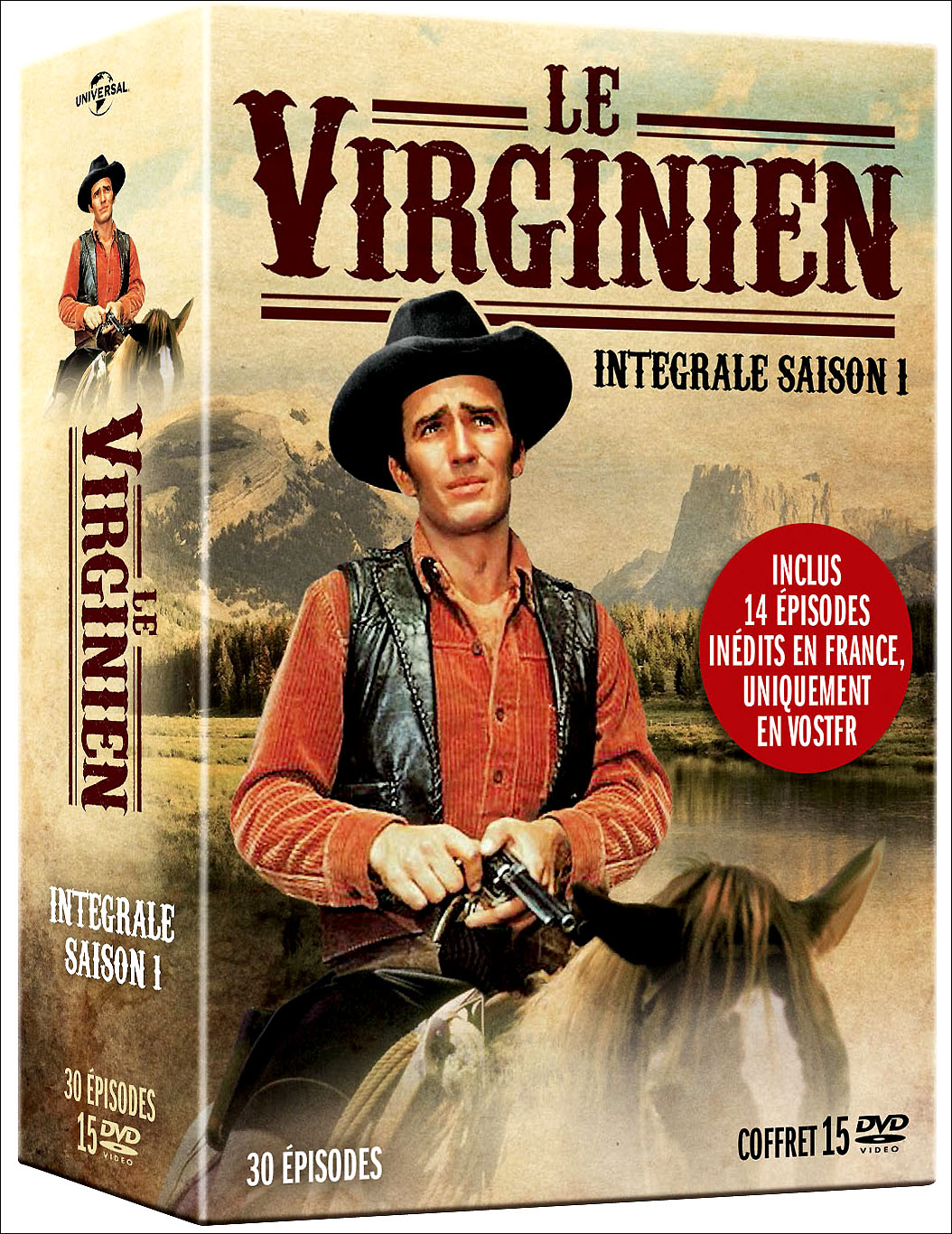
THE VIRGINIAN - SEASON 1 ON DVD (ELEPHANT FILMS)

The Virginian, the classic western series starring James Drury and Doug McClure, ran for 9 seasons and 249 75-minute episodes on U.S. network NBC from 1962 to 1971. It is available on DVD (All Zone) from Elephant Films, which first released the fully restored series in its entirety from 2014, including episodes never shown on French television.

Now Elephant makes The Virginian available again, starting with seasons 1 to 3 (since last month). They can be bought individually or in "Le Virginien - Intégrale Volume 1 - Saisons 1 à 3" boxset. Seasons 4 to 6 will follow in July.

The Virginian is set in Medicine Bow, Wyoming at the end of the 19th century and centered on the charismatic and enigmatic foreman of the Shiloh Ranch, only known as  "The Virginian". The character was created by American writer Owen Wister (1860-1938) for his novel The Virginian: A Horseman of the Plains, first published in 1902. The book was adapted for the stage as of 1903 and there were four movies based on Wister's work between 1914 and 1946. In the late 1950s, The Virginian raised the interest of Frank Price, a story editor at Screen Gems (the television arm of Columbia Pictures), who recommended it for a possible series. The company produced a 30-minute black and white pilot written by Leslie Stevens (creator of the 1963-1965 sci-fi series The Outer Limits) and starring James Drury, a young actor from New York, as The Virginian. The pilot didn't sell and was recycled as an episode of Decision, an anthology shown by NBC during summer 1958. But Frank Price and James Drury would hear again of The Virginian.

The western genre was very popular on U.S. television in the 1950s and 1960s. The first two most watched shows of the 1961-1962 season were NBC's westerns Wagon Train (1957-1965) and Bonanza (1959-1973). The third was Gunsmoke (1955-1975) on CBS, a western too. Wagon Train was produced by Revue Studios, the TV subsidiary of MCA (Music Corporation of America). Revue was also behind western series Tales of Wells Fargo (1957-1962) and Laramie (1959-1963) for NBC and Rawhide (1959-1965), co-starring Clint Eastwood, for CBS. In 1961, Jennings Lang, vice president of distributor MCA TV, sold Wagon Train to ABC for $20 million (reruns included) after NBC refused the price proposed by MCA at the end of their five-year contract. Lang gave the executives of NBC something bigger to replace America's #1 programme... The Virginian, television's first 90-minute (with commercial breaks) western series. He asked Frank Price, who joined Revue in 1959, to write the format. 

NBC greenlit the series, to be filmed in colour (1) on 35mm and without a pilot. The network called The Virginian "the most ambitious and costly programming in network television history" and explained that the 90 minutes allowed full character development and expanded storytelling. They promised location shooting and "at least one major guest star" every week (2). In March 1962, it was announced that Broadway and film actor Lee J. Cobb (12 Angry Men, On the Waterfront) would play the key role of Judge Henry Garth, the owner of the Shiloh Ranch. The rest of the main cast was revealed in May: four years after the Screen Gems pilot, James Drury was chosen to be The Virginian. Doug McClure (Overland Trail, Checkmate) got the role of Trampas, the fun-loving top hand of The Virginian though he was a bad guy in the book. Gary Clarke (Michael Shayne) was given the part of Steve Hill, a young cowboy. 

The other regular characters announced were newspaper owner Molly Wood, portrayed by Pippa Scott, and Judge Garth's teenage daughter Betsy, played by Roberta Shore. Revue's Richard Irving was to serve as executive producer and Frank Price as producer but Charles Marquis Warren (Rawhide, Gunsmoke) was named executive producer of The Virginian instead. Filming started in May 1962 with multiple production units working simultaneously to provide the 30 75-minute episodes planned. The shooting schedule required to make two or three episodes at the same time, hence the variable presence of the main characters from an episode to another. With a budget estimated as much as $500,000 each on some episodes (3) and a duel vs Wagon Train on wednesdays to begin in fall 1962, failure was not an option.  

Long before the launch of The Virginian, NBC and Revue Studios grew dissatisfied with the work of Charles Marquis Warren and decided to replace him. MCA hired Roy Huggins as a consultant to assess the problems of the 13 episodes already produced and fix them. Huggins was a novelist, scriptwriter and producer who worked for Columbia Pictures, RKO, Warner Bros. and 20th Century Fox. For television, he created the hit series Cheyenne (1955-1962), Maverick (1957-1962) and 77 Sunset Strip (1958-1964). Roy Huggins called Frank Price and Joel Rogosin to assist him and asked director Richard L. Bare to shoot new scenes. Charles Marquis Warren remained credited until mid-season, then Roy Huggins and Frank Price officially became executive producer and producer (respectively).  

Roy Huggins wrote the stories of several episodes (4). Westerns scriptwriter and director Burt Kennedy, who penned the story of an episode and helmed it, later directed Return of the Seven (1966) and Support Your Local Sheriff (1969). Samuel Fuller wrote and directed an episode before doing the film Shock Corridor (1963). One of the writers, Roland Kibbee, created It Takes a Thief (1968-1970). Other directors include Earl Bellamy, James Sheldon, Douglas Heyes, movie serials veterans William Witney and John English or Ted Post. The latter directed Clint Eastwood in Hang'Em High (1968) and Magnum Force (1973). The other producers of The Virginian (season 1) were Morton Fine & David Friedkin, Roland Kibbee, Warren Duff and Winston Miller.

Percy Faith (Tammy Tell Me True) composed the theme music of The Virginian. Richard Shores, Morton Stevens and Pete Rugolo are among the composers who worked on the season 1 soundtrack. This first season aired from September 1962 to May 1963 on NBC and its list of guest stars is impressive right from The Executioners, the first episode shown. Fresh from The Life and Legend of Wyatt Earp (1955-1961), Hugh O'Brian plays a man who arrives at Medicine Bow after a hanging. He seduces the school teacher played by Colleen Dewhurst. Ricardo Montalbán, of Fantasy Island and Star Trek fame, displays his customary flamboyance as a Columbian gentleman in The Big Deal. George C. Scott is a teacher who recites Oscar Wilde in The Brazen Bell. Lee Marvin is a villain in It Tolls For Thee, Samuel Fuller's episode. 

Bette Davis plays a bank clerk in The Accomplice. Tom Tryon (Texas John Slaughter) is a seaman in The Man from the Sea. Vera Miles (Psycho) guest stars in The Man Who Couldn't DieMichael Rennie (The Day the Earth Stood Still) faces Nina Foch in Vengeance is the Spur. In The Golden DoorKarlheinz Böhm (Peeping Tom, Sissi) portrays an immigrant accused of murder. Actress, director, writer and producer Ida Lupino guest star with her then husband Howard Duff in A Distant Fury. Singer Nancy Sinatra is a saloon singer in If You Have Tears. Many familiar faces appear throughout the first season, such as Jack Warden, Eddie Albert, Robert Colbert, Tom Skeritt, James Gregory, Harold Gould, Victor French, Carol Lynley, Steve Forrest, David White, Bradford Dillman, Ed Asner, Don Galloway, etc. Even Robert Vaughn before The Man from U.N.C.L.E., a pre-fame Robert Duvall, as well as future pop culture icons DeForest Kelley and James Doohan (Star Trek). 

Katherine Crawford, who plays Alice Lawford in the episode Say Goodbye to All That, is the daughter of Roy Huggins. She married Frank Price in 1965. Two episodes from season 1 are the remakes of westerns produced by Universal Pictures. Duel at Shiloh, which explains how Steve Hill came to work at the ranch, is based on the screenplay of Man Without a Star (1955) and a 1952 novel. Brian Keith guest stars as the character played by Kirk Douglas in the film. The Judgment is adapted from Day of the Badman (1958). Clu Gulager, who plays the villain, returned in a different role in 1963 and as Deputy Sheriff Emmett Ryker from season 3 to season 6. Ross Elliott recurred as Sheriff Mark Abbott from season 1 to season 7 (except for season 4). MCA decided to release some episodes of The Virginian in theaters abroad to recoup some of the production costs, starting with The Brazen Bell

In 1962, MCA acquired record company Decca, the owner of Universal Pictures, and Revue Studios was renamed Universal Television the following year. MCA formed Universal City Studios in 1964 to oversee their film and television activities. The Virginian was renewed for a second season. Its third season ranked #22 in the ratings and launched a spin-off, Laredo (1965-1967). Season 5 reached the Top 10. For its ninth season, the title changed for The Men from Shiloh and a new theme music was composed by Ennio Morricone. Only James Drury and Doug McClure stayed for the entire series. The success of The Virginian prompted Wagon Train to switch to colour and 90 minutes for its seventh season (1963-1964) (5) and paved the way for more 90-minute programmes with continuing characters, like western Cimarron Strip (1967-1968) on CBS or NBC's The Name of the Game (1968-1971) and The NBC Mystery Movie (1971-1977).

Roy Huggins created The Fugitive (1963-1967) for ABC and stayed at Universal Television as a vice president (until 1966) and executive producer. There, he created and/or exec produced Run for Your Life (1965-1968), The Outsider (1968-1969), The Lawyers (1968-1972), Alias Smith and Jones (1971-1973) (6), Cool Million (1972), Toma (1973-1974), The Rockford Files (1974-1980, co-created with Stephen J. Cannell), Baretta (1975-1978, created by Stephen J. Cannell) and City of Angels (1976, created with Cannell). Huggins came out of retirement in 1985 to become the executive producer of Hunter (1984-1991). After The Virginian, James Drury did some stage work and starred in the short-lived Firehouse (1974). He guest starred in a lot of series and attended numerous western festivals and conventions.

Doug McClure rotated the lead with Hugh O'Brian and Tony Franciosa in Search (1972-1973). He replaced Dennis Cole in Barbary Coast (1975-1976) after the pilot. The TV movie Satan's Triangle (1975), where he played alongside Kim Novak, is cult in France. His last regular role in a series was in Out of This World (1987-1991). On the big screen, McClure starred in The Land That Time Forgot (1974), At The Earth's Core (1976) or The People That Time Forgot (1977). Selected episodes of The Virginian arrived on French television from 1966. The "Le Virginien - Intégrale Saison 1" 15-disc boxset from Elephant Films contains the 30 episodes of season 1. The languages are French and English (with French subtitles). 14 episodes unaired on French TV are in English only.

Bonus material is comprised of an interview with James Drury, an interview with Roberta Shore and the trailers of other titles from Elephant: The Rockford Files, Kolchak: The Night Stalker (1974-1975), Madigan and The Equalizer (with Edward Woodward). An incredible concentration of talents (on and off screen), likeable main characters, interesting supporting characters, various stories and a beautiful colour cinematography make these boxsets of The Virginian indispensable.

(1) Bonanza was the first TV western to be filmed in colour. Alex Quiroga, the colour consultant of Bonanza worked on the first four seasons of The Virginian.
(2) NBC
Press release (August 29, 1962).
(3) Sponsor
(March 19, 1962).
(4)
Under the pseudonyms of Thomas Fitzroy and John Francis O'Mara.
(5)
Wagon Train reverted to black and white and 60 minutes for its eighth and final season.
(6) The Girl in Boxcar #3, a season 1 episode of Alias Smith and Jones, is based on a story by Gene Roddenberry (Star Trek) written for an episode of the first season of The Virginian titled Run Away Home.

https://fr.shopping.rakuten.com/mfp/5472590/serie-le-virginien?pid=10516775904 (Intégrale Saison 1)
https://fr.shopping.rakuten.com/mfp/shop/5472590/serie-le-virginien?pid=10516775905 (Intégrale Saison 2)
https://fr.shopping.rakuten.com/mfp/5472590/serie-le-virginien?pid=10516775908 (Intégrale Saison 3)
https://fr.shopping.rakuten.com/offer/buy/10516775909/le-virginien-volume-1-saisons-1-a-3.html (Intégrale Volume 1 - Saisons 1 à 3)
http://www.elephantfilms.com
https://fr.shopping.rakuten.com/boutique/ElephantFilm

See also: